EVENTS

Roundtable | Policy Brief on the EU Green Deal’s Externalisation in Brazil
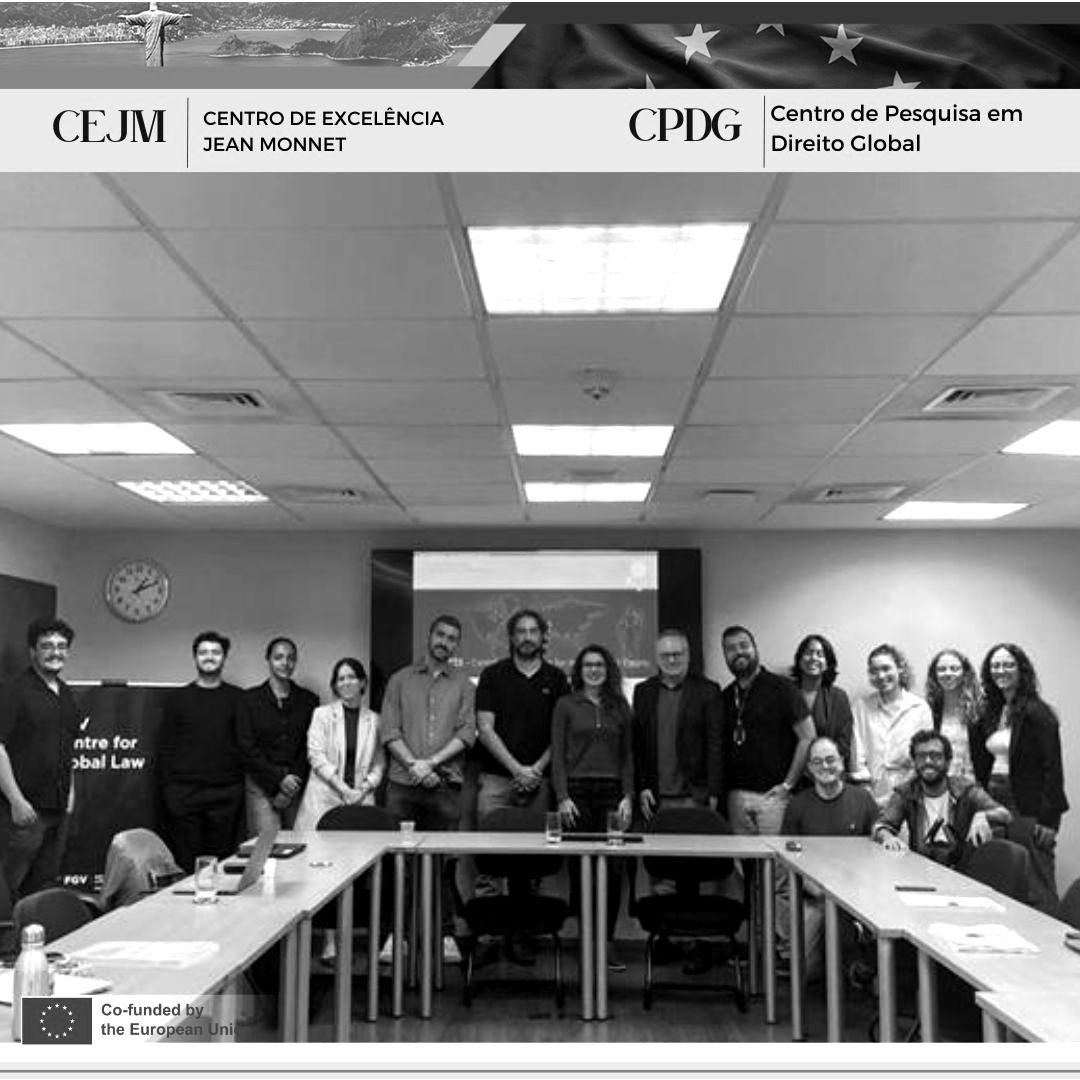
On August 13, CPDG and CEJM held a roundtable to discuss our forthcoming Policy Brief on the EU Green Deal's externalisation in Brazil — covering the EU Deforestation Regulation (EUDR) and the EU–Mercosur Agreement. The Policy Brief is a product of the project 'Regulating Forests', held in partnership with the Climate and Society Institute (ICS) and cofunded by the European Union, under the Eramus+ Programme.
We were honoured to welcome representatives from the Ministry of Foreign Affairs (Ministério das Relações Exteriores), the Ministry of Environment and Climate Change (Ministério do Meio Ambiente e Mudanças Climáticas), and the National Institute for Space Research (Instituto Nacional de Pesquisas Espaciais), alongside our own CPDG and CEJM research team. The discussion was held at closed-doors and under the Chatham House Rules to allow for an informal debate.
Professor Paula Wojcikiewicz Almeida, Director of CPDG and CEJM, and senior researcher Mariana Mariani presented the Policy Brief's main findings and policy recommendations. The government stakeholders engaged closely with the document, offering comments and raising questions in what proved to be a rich and constructive discussion.
We are happy to bring academic research directly into dialogue with policymakers and government officials, and we are now incorporating all the comments we have received into the final version of the Policy Brief, to be released in early September. Stay tuned!

Research Seminar | Doctoral Thesis Presentation by Benedetta Arrighini — "Cooperation in Criminal Matters and the Rule of Law in the EU and Mercosur: From Comparative Regionalism to Interregional Relations"
On 17 July 2026, the Centre for Global Law (CPDG) and the Jean Monnet Centre of Excellence (CEJM), co-funded by the European Union, both at FGV Rio Law, held a research seminar on the doctoral thesis of PhD candidate Benedetta Arrighini.
Arrighini is a Ph.D. Fellow in International and European Law at ULB Bruxelles, FGV Direito Rio, and Luiss Rome, with a Master's from the University of Trento and an LL.M. from the College of Europe, Bruges; she is also a qualified lawyer in Italy. Her thesis, "Cooperation in Criminal Matters and the Rule of Law in the EU and Mercosur: From Comparative Regionalism to Interregional Relations," developed under the co-supervision of Professor Paula Wojcikiewicz Almeida within the GEM Diamond programme, examines how interregional cooperation in criminal matters can be built while safeguarding the rule of law, comparing EU–Mercosur and EU–Brazil relations.
Ms. Arrighini presented her main arguments, theoretical framework, methodology, and findings, followed by a Q&A led by researcher Lucas Vollers with active participation from CPDG and CEJM researchers — an engaging exchange ahead of her official defense later this year.

Summer School on Global Comparative Private Law | Salzburg 2026 — Lecture: "The Application of International and Regional Private International Law Sources in Brazil"
Professor Paula Wojcikiewicz Almeida, director of the Centre for Global Law (CPDG) and of the Jean Monnet Centre of Excellence on EU-Latin America Global Challenges (CEJM), co-funded by the European Union under the Erasmus+ programme, delivered a lecture in the 27th edition of the Summer School on Global Comparative Private Law. The event, held in Salzburg, Austria, between 1 July and 13 July, is organized by the Paris Lodron University of Salzburg.
The two-week course covers essential concepts from around 30 different legal systems and features over 50 professors from various countries and legal traditions. The objective is to prepare participants in the fields of global comparative private law for an increasingly globalized and demanding market.
Professor Paula Wojcikiewicz Almeida gave a lecture on "The Application of International and Regional Private International Law Sources in Brazil", which aims to address pressing issues of private international law and its application in Brazil, such as the recent draft legislation and the incorporation of the EU-Mercosur FTA, and also took part in workshops on practical cases of comparative private law.
Research Seminar | "The EU–Mercosur Agreements: Procedural and Substantive Challenges
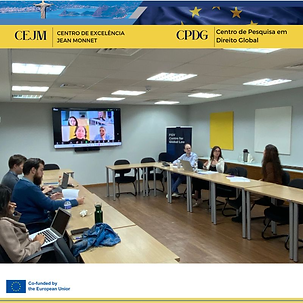
On 19 June 2026, the Centre for Global Law (CPDG) and the Jean Monnet Centre of Excellence on EU-LA Global Challenges (CEJM), both based at FGV Rio Law School and co-funded by the European Union under the Erasmus+ Programme, held a research seminar on the working paper "The EU–Mercosur Agreements: Procedural and Substantive Challenges."
Researchers Leonardo Bortolozzo Rossi and Léa Guillaumier presented the study, developed under the supervision of Professor Paula Wojcikiewicz Almeida, director of CPDG and CEJM. The presentation examined the procedural challenges of the EU–Mercosur Agreements from an EU perspective — including the splitting technique, the provisional application of the Interim Trade Agreement since 1 May 2026, and the Trade and Sustainable Development Chapter — tracing these tensions back to the evolving jurisprudence of the Court of Justice of the European Union on the Common Commercial Policy.
A Q&A session followed, led by Professor Wojcikiewicz Almeida with the CPDG and CEJM researchers. The working paper is currently being prepared for submission to the European Law Journal.

Webinar | "The Externalisation of the EU Green Deal in Latin America through Intra- and Inter-Regional Instruments: the EUDR and the EU–Mercosur Agreement"
10 June 2026, the FGV Centre for Global Law (CPDG) and the Jean Monnet Centre of Excellence on EU–Latin America Global Challenges (CEJM), co-funded by the European Union under the Erasmus+ programme and directed by Prof. Paula Wojcikiewicz Almeida, held the webinar "The Externalisation of the EU Green Deal in Latin America through Intra- and Inter-Regional Instruments: the EUDR and the EU–Mercosur Agreement". The Webinar was supported by the Climate and Society Institute (ICS).
We were honoured to welcome such distinguished speakers from across the EU and Brazil for what proved to be a truly fruitful exchange on one of the most pressing intersections of trade and environmental global governance.
The webinar opened with a keynote address by Frank Hoffmeister (Head of the Legal Department, EEAS), who set the stage by reflecting on international trade and sustainable development between bilateral and multilateral approaches.
Panel I, chaired by Prof. Paula Wojcikiewicz Almeida (Director of CPDG and CEJM and Professor at FGV Rio Law), examined the EUDR as an intra-regional instrument of the EU Green Deal, featuring Josephine Norris (Member of the European Commission Legal Service), Matheus Soares Matos (Barral Pinheiro Parente Law Firm), and Gustavo Gayger Müller (Senior Researcher at KU Leuven), with Mariana Mariani (CPDG/CEJM) as discussant.
Panel II, chaired by Augusto Castro (Brazil's Ministry of Foreign Affairs), turned to the EU–Mercosur Agreement as an inter-regional instrument, bringing together Pedro Mariano Martins Pontes (Brazil's Ministry of the Environment and Climate Change), Paolo Garzotti (DG Trade, European Commission), and Henrique Choer Moraes (Deputy Ambassador to the Netherlands), with Leonardo Rossi (CPDG/CEJM) as discussant.
Closing remarks were delivered by Prof. Jan Wouters (Director at the KU Leuven Centre for Global Governance Studies).
The discussions offered rich insights into the extraterritorial effects of Regulation (EU) 2023/1115, the Trade and Sustainable Development chapter of the EU–Mercosur Agreement, and the interaction between these two frameworks — including Annex 18-A of the EU-Mercosur Agreement and recent EUDR simplification measures that may shape how Brazil's compliance systems are recognised under EU law.
Research Seminar | “The EU–Mercosur Trade Agreements: Procedural and Substantive Challenges”
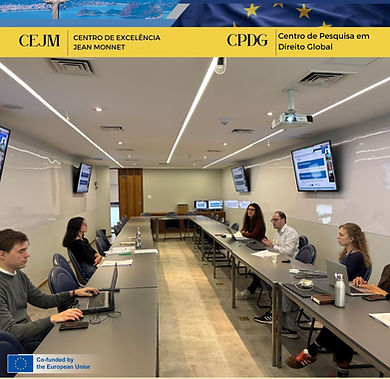
On 22 May 2026, the Centre for Global Law (CPDG) and the Jean Monnet Centre of Excellence (CEJM) at FGV Rio Law organised a research seminar on the working paper “The EU-Mercosur Trade Agreements: Procedural and Substantive Challenges”, moderated by Professor Paula Wojcikiewicz Almeida. Researcher Leonardo Bortolozzo Rossi presented the draft paper within the research project Climate Change and Forests.
The seminar also welcomed a representative from the Brazilian Ministry of Foreign Affairs and an invited expert in customs law, international trade, and regional integration as discussants, fostering dialogue on the legal and policy challenges surrounding EU–Mercosur relations from both regional perspectives.

Reseach Seminar | “Challenges of the EU Deforestation-Free Regulation for Brazil: Insights from the Coffee Sector”
On 15 May 2026, the Centre for Global Law (CPDG) and the Jean Monnet Centre of Excellence (CEJM) at FGV Rio Law organised a research seminar on the indirect application of the EU Deforestation-Free Regulation (EUDR) in Brazil, with particular attention to the coffee sector. Researchers Mariana Mariani, Léa Guillaumier, Camilla Rosso and Leonardo Bortolozzo Rossi presented the working paper “Challenges of the EU Deforestation-Free Regulation for Brazil: Insights from the Coffee Sector”, developed under the supervision of Professor Paula Wojcikiewicz Almeida.
The seminar also welcomed an invited expert from the Brazilian public sector working on environmental governance and international cooperation as discussant, whose comments and feedback contributed to the ongoing development of the research.
Research Seminar | “The Externalisation of the European Green Deal in South America: EUDR’s Effects and the EU–Mercosur Agreement”
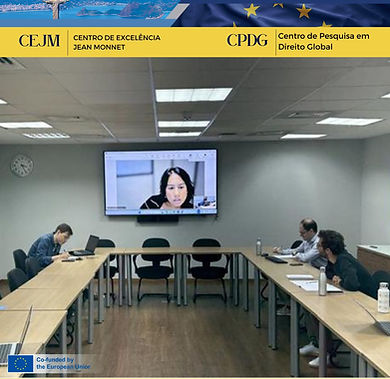
On 19 March 2026, the Centre for Global Law (CPDG) and the Jean Monnet Centre of Excellence (CEJM) at FGV Rio Law organised an in-house research seminar dedicated to the working paper “The Externalisation of the European Green Deal in South America: EUDR’s Effects and the EU–Mercosur Agreement.”
Researchers Mariana Mariani and Leonardo Bortolozzo Rossi presented the paper, co-authored with Professor Paula Wojcikiewicz Almeida. The research examines how different channels of externalisation of the European Green Deal shape EU–South America environmental relations, focusing on the interaction between unilateral regulatory instruments and trade agreements embedding sustainability commitments.
The seminar concluded with comments, feedback, and discussion among researchers from CPDG and CEJM.
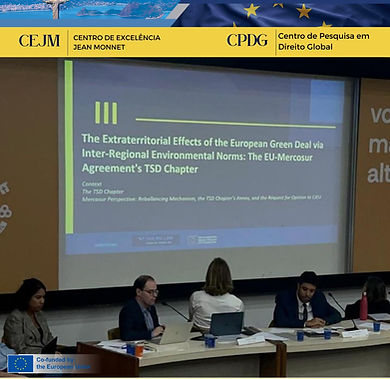
EULAS Conference Presentation | “The Externalisation of the European Green Deal and South America: EUDR’s Effects and the EU–Mercosur Agreement”
On 24 March 2026, researchers from the Centre for Global Law (CPDG) and the Jean Monnet Centre of Excellence (CEJM) at FGV Rio Law participated in the EULAS Conference – Euro-Latin America & Caribbean Cooperation in Governing Climate and Biodiversity and Achieving the Sustainable Development Goals.
Researchers Mariana Mariani and Leonardo Bortolozzo Rossi presented the paper “The Externalisation of the European Green Deal and South America: EUDR’s Effects and the EU–Mercosur Agreement”, co-authored with Professor Paula Wojcikiewicz Almeida. The research examines the externalisation of the European Green Deal in South America, focusing on the interaction between the EU Deforestation Regulation (EUDR), the EU–Mercosur Agreement, and their legal and regulatory implications for Brazil.
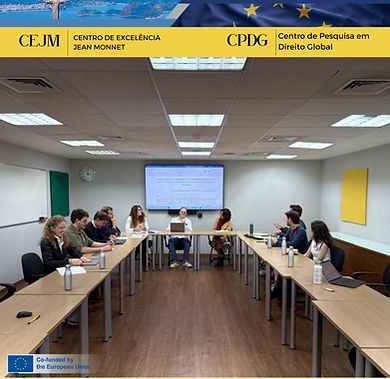
Research Seminar | “Conceptualisation and Operationalisation of Trade and Sustainable Development Clauses in the EU–Mercosur Free Trade Agreement: Comparative Structures, Divergences, and Effectiveness”
On 27 February 2026, the Centre for Global Law (CPDG) and the Jean Monnet Centre of Excellence (CEJM) at FGV Rio Law organised an in-house research seminar dedicated to the working paper “Conceptualisation and Operationalisation of Trade and Sustainable Development Clauses in the EU–Mercosur Free Trade Agreement: Comparative Structures, Divergences, and Effectiveness.”
Researchers Mariana Mariani and Leonardo Bortolozzo Rossi presented the paper, which examines how trade and sustainability interact within the Trade and Sustainable Development chapters of EU trade agreements, focusing on the rationale behind these provisions, differences between labour and environmental commitments, and challenges related to implementation and enforcement.